
This dissertation explores the potential of quantum computing in procedural terrain generation, comparing classical noise mapping techniques with quantum approaches. The study leverages Python and the Qiskit library, showcasing a deep dive into a new coding paradigm and gaining a comprehensive understanding of quantum physics. It also demonstrates the integration of quantum computing results into…
Key Achievements
- Adapting to Quantum Computing: Successfully adapted to a new coding paradigm using Python and the Qiskit library, gaining a deeper understanding of quantum physics principles.
- Quantum Circuit Integration: Developed quantum circuits for procedural terrain generation and integrated their results into a Unity-based terrain generator.
- Procedural Terrain Generator: Modified the procedural terrain generator to accept files created by running quantum circuits, enhancing the versatility of terrain generation techniques.
- Flask Integration: Used Flask to queue quantum circuits and read results directly into Unity, showcasing effective cross-platform integration.
Methodology
1. Creation of a Procedural Noise Map Generator in Unity
Developed a procedural noise map generator in Unity to visualize and compare noise maps generated by classical and quantum methods.
- Scripts Used:
MapGenerator.cs: Handles noise map generation.TextureGenerator.cs: Converts noise data into textures.MapDisplay.cs: Renders generated maps in Unity.
2. Implementation of Perlin Noise for Comparison
Implemented Perlin noise in Unity to serve as a baseline for comparing with quantum-generated noise maps.
- Script:
Noise.cs: Generates Perlin noise maps with customizable parameters for octaves, frequency, persistence, lacunarity, and normalization.
3. Quantum Circuits Development
Set up a development environment using Qiskit within Jupyter Notebook for creating and testing quantum circuits.
- Qiskit: Open-source quantum computing framework developed by IBM.
- Jupyter Notebook: Used for interactive development and visualization of quantum algorithms.
4. Exploration of Quantum Procedural Noise Map Generation
Experimented with various quantum algorithms to generate procedural noise maps.
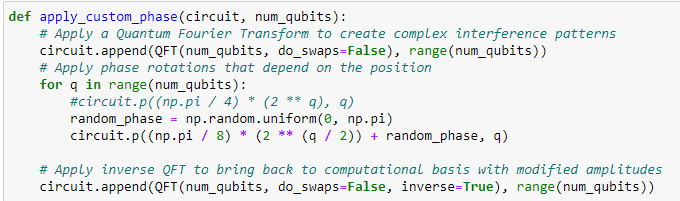
- Phase Shifts: Implemented gradient, balanced, and custom phase shifts.
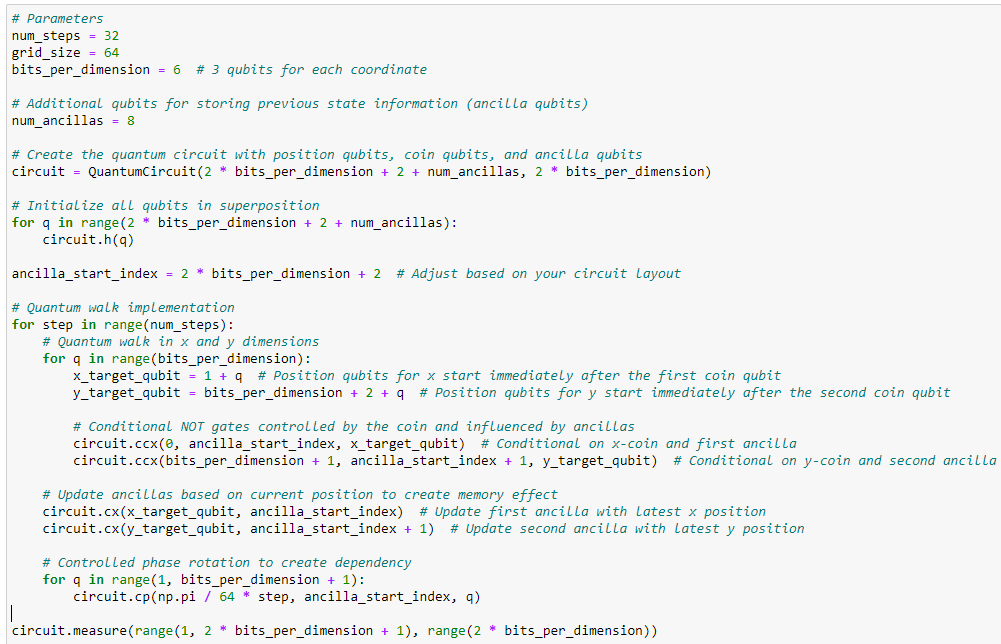
- Quantum Walks: Utilized quantum walks to explore multiple paths simultaneously, generating complex noise structures.
5. Visualization and Improvement Trials
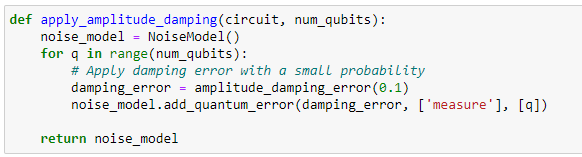
Developed visualization techniques to quickly evaluate quantum noise patterns and incorporated noise models to simulate real quantum machine disturbances.
6. Overcoming Challenges with Real Quantum Computers
Used the Qiskit Sampler to execute quantum circuits on IBM’s quantum computers, applying error mitigation techniques to refine the outputs.
Results and Analysis
- Efficiency Comparison: Evaluated the efficiency of classical Perlin noise against quantum methods, highlighting current limitations in quantum computing.
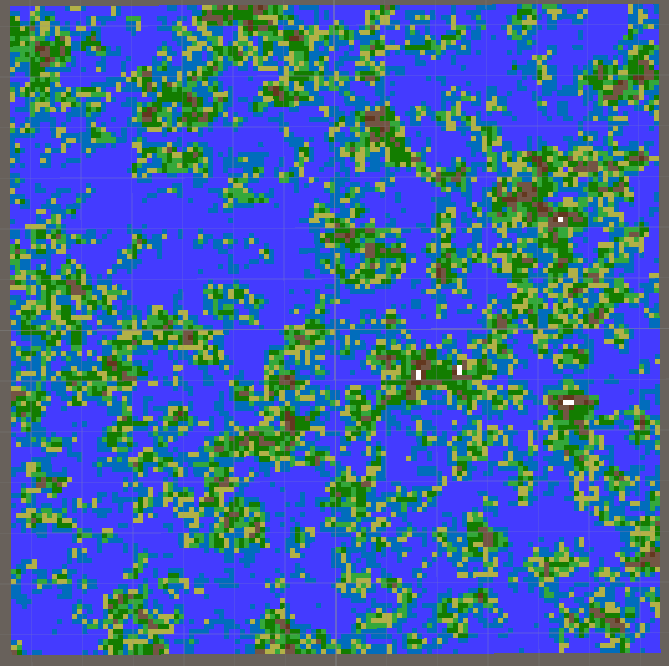
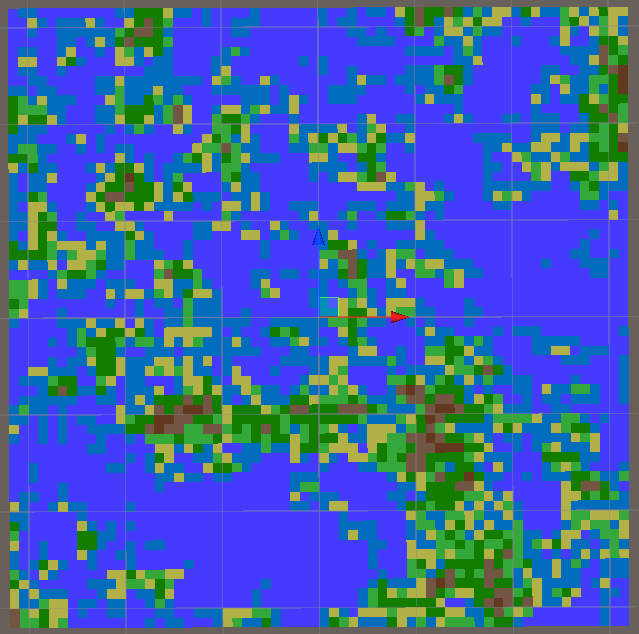
- Output Characteristics: Compared the unique characteristics of terrains generated by classical and quantum methods, showcasing the potential of quantum-generated noise maps.
- Viability and Scalability: Assessed the practical viability of integrating quantum methods into game development workflows.
Conclusion
The dissertation concludes that while quantum methods offer unique attributes, they currently face practical challenges in implementation. Future research should focus on advancing quantum algorithms, developing hybrid methods, and exploring cloud-based quantum computing services to democratize access to quantum resources.
References:A quantum procedure for map generation. (2020, August 1). IEEE Conference Publication | IEEE Xplore. https://ieeexplore.ieee.org/abstract/document/9231571
A survey of procedural terrain generation techniques using evolutionary algorithms. (2012, June 1). IEEE Conference Publication | IEEE Xplore. https://ieeexplore.ieee.org/abstract/document/6256610
Algorithms and Approaches for Procedural Terrain Generation – A brief review of current techniques. (2016, September 1). IEEE Conference Publication | IEEE Xplore. https://ieeexplore.ieee.org/abstract/document/7590336/authors#authors
Arute, F., Arya, K., Babbush, R., Bacon, D., Bardin, J. C., Barends, R., Biswas, R., Boixo, S., Brandão, F. G. S. L., Buell, D. A., Burkett, B., Chen, Y., Chen, Z., Chiaro, B., Collins, R., Courtney, W., Dunsworth, A., Farhi, E., Foxen, B., . . . Martinis, J. M. (2019). Quantum supremacy using a programmable superconducting processor. Nature, 574(7779), 505–510. https://doi.org/10.1038/s41586-019-1666-5
Azure Quantum | Azure Quantum Homepage. (n.d.). https://quantum.microsoft.com/
Cho, C., Chen, C., Chen, K., Huang, T., Hsu, M., Cao, N., Zeng, B., Tan, S., & Chang, C. (2021). Quantum computation: Algorithms and Applications. Chinese Journal of Physics/Zhōngguó Wùlǐ Xuékān, 72, 248–269. https://doi.org/10.1016/j.cjph.2021.05.001
Cloud Quantum Computing Service – Amazon Braket – AWS. (n.d.). Amazon Web Services, Inc. https://aws.amazon.com/braket/
Google Quantum AI. (n.d.). Google Quantum AI. https://quantumai.google/
IBM Quantum Documentation. (n.d.). IBM Quantum Documentation. https://docs.quantum.ibm.com/
Implementing Grover’s algorithm on the IBM Quantum computers. (2018, December 1). IEEE Conference Publication | IEEE Xplore. https://ieeexplore.ieee.org/document/8622457
Joo, J., Park, Y. J., Oh, S., & Kim, J. (2003). Quantum teleportation via aWstate. New Journal of Physics, 5, 136. https://doi.org/10.1088/1367-2630/5/1/136
Perlin, K. (1985). An image synthesizer. Computer Graphics, 19(3), 287–296. https://doi.org/10.1145/325165.325247
Quantum computation and quantum information. (n.d.). Google Books. https://books.google.co.uk/books?hl=ro&lr=&id=-s4DEy7o-a0C&oi=fnd&pg=PR17&dq=Nielsen,+M.+A.,+%26+Chuang,+I.+L.+(2010).+Quantum+Computation+and+Quantum+Information.+Cambridge+University+Press.+&ots=NJ2Hgmsw_r&sig=oknCUApwg6zZZXqW9johVSYZLOk#v=onepage&q=Nielsen%2C%20M.%20A.%2C%20%26%20Chuang%2C%20I.%20L.%20(2010).%20Quantum%20Computation%20and%20Quantum%20Information.%20Cambridge%20University%20Press.&f=false
Quantum computing since Democritus. (n.d.). Google Books. https://books.google.co.uk/books?hl=ro&lr=&id=jRGfhSoFx0oC&oi=fnd&pg=PR9&dq=Aaronson,+S.+(2013).+Quantum+computing+since+Democritus.+Cambridge+University+Press.+&ots=PGJEO_6wjU&sig=UifRijFqWH3LLZrE7Jk9zZViHhs#v=onepage&q=Aaronson%2C%20S.%20(2013).%20Quantum%20computing%20since%20Democritus.%20Cambridge%20University%20Press.&f=false
Rieffel, E., & Polak, W. (2000). An introduction to quantum computing for non-physicists. ACM Computing Surveys, 32(3), 300–335. https://doi.org/10.1145/367701.367709
Schaal, J. (2017). Procedural Terrain Generation. A Case Study from the Game Industry. In Springer eBooks (pp. 133–150). https://doi.org/10.1007/978-3-319-53088-8_8
Skult, N., & Smed, J. (2021). The marriage of quantum computing and interactive storytelling. In International series on computer entertainment and media technology (pp. 191–206). https://doi.org/10.1007/978-3-030-81538-7_13
Valencia-Rosado, L. O., & Starostenko, O. (2019). Methods for Procedural Terrain Generation: A review. Lecture Notes in Computer Science, 58–67. https://doi.org/10.1007/978-3-030-21077-9_6
Voorhoede, D. (n.d.). Quantum inspire. Quantum Inspire. https://www.quantum-inspire.com/
Wootton, J. R. (2020). Procedural generation using quantum computation. FDG ’20: Proceedings of the 15th International Conference on the Foundations of Digital Games. https://doi.org/10.1145/3402942.3409600
Wootton, J. R. (2022). The history of games for (Quantum) computers. In Springer eBooks (pp. 345–367). https://doi.org/10.1007/978-3-030-95538-0_10
Worley, S. (1996). A cellular texture basis function. Proceedings of the 23rd Annual Conference on Computer Graphics and Interactive Techniques. https://doi.org/10.1145/237170.237267: Exploring Quantum Computing’s Potential in Terrain Generation: A comparative study
Leave a Reply