
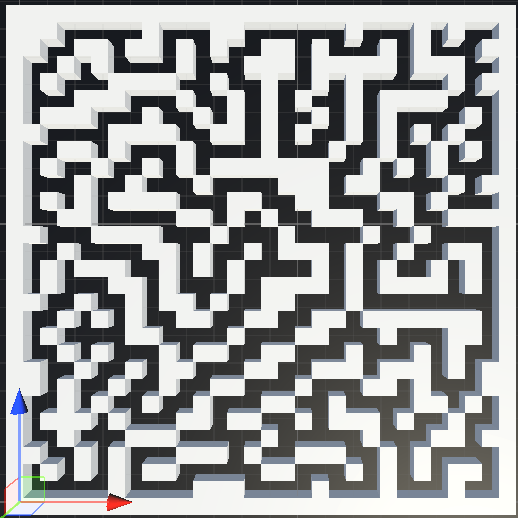
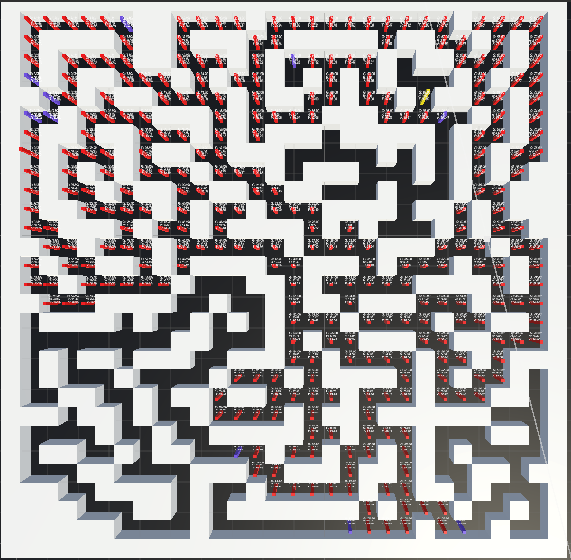
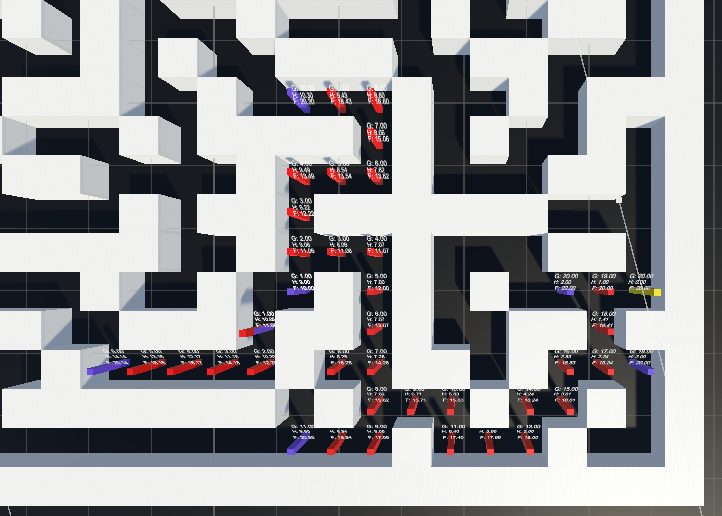
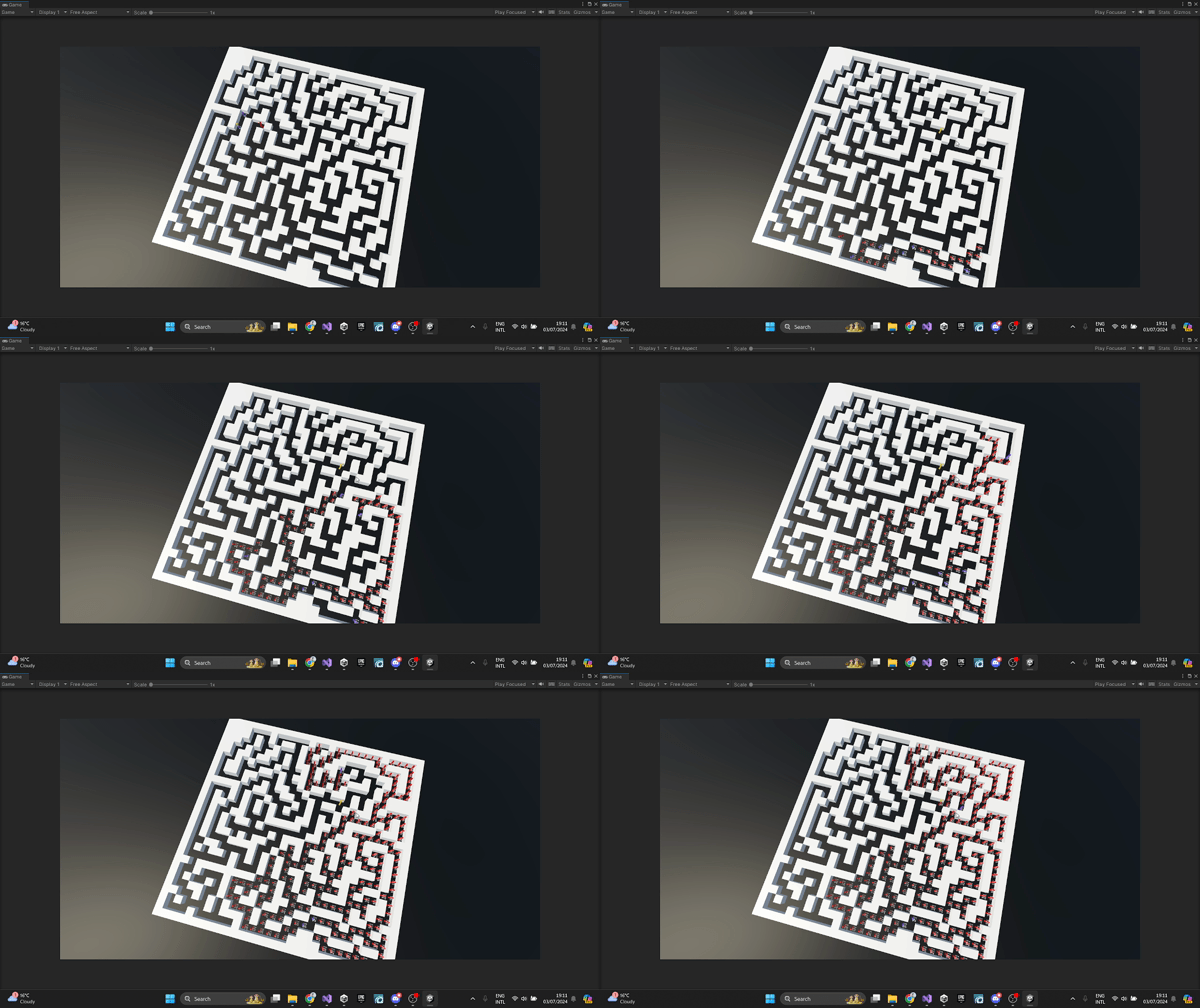
This project demonstrates the implementation of the A* pathfinding algorithm within a randomly generated maze. The maze generation is achieved using a recursive division algorithm, and the pathfinding process is visualized in real-time, showcasing the F, G, and H values used to determine the optimal path.
This project showcases the implementation of the A* pathfinding algorithm within a randomly generated maze. The combination of recursive maze generation and real-time visualization of the pathfinding process provides a comprehensive demonstration of algorithmic thinking and problem-solving skills.
Core Features
- Random Maze Generation: Utilizes a recursive division algorithm to create complex and varied mazes.
- A Pathfinding Algorithm*: Implements the A* algorithm to find the shortest path from the start point to the endpoint.
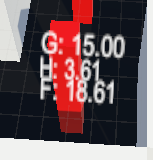
- Real-Time Visualization: Displays the F, G, and H values for each node during the pathfinding process, providing a clear understanding of the algorithm’s decision-making.
- Interactive Controls: Allows users to generate new mazes and initiate the pathfinding process with keyboard inputs.
Key Components
1. A* Pathfinding (FindPathAStar.cs)
This script implements the A* pathfinding algorithm, calculating the F, G, and H values for each node and visualizing the search process.
using System;
using System.Collections;
using System.Collections.Generic;
using UnityEngine;
using System.Linq;

public class PathMarker {

    public MapLocation location;
    public float G, H, F;
    public GameObject marker;
    public PathMarker parent;

    public PathMarker(MapLocation l, float g, float h, float f, GameObject m, PathMarker p) {

        location = l;
        G = g;
        H = h;
        F = f;
        marker = m;
        parent = p;
    }

    public override bool Equals(object obj) {

        if ((obj == null) || !this.GetType().Equals(obj.GetType()))
            return false;
        else
            return location.Equals(((PathMarker)obj).location);
    }

    public override int GetHashCode() {

        return 0;
    }
}

public class FindPathAStar : MonoBehaviour {

    public Maze maze;
    public Material closedMaterial;
    public Material openMaterial;
    public GameObject start;
    public GameObject end;
    public GameObject pathP;

    PathMarker startNode;
    PathMarker goalNode;
    PathMarker lastPos;
    bool done = false;

    List<PathMarker> open = new List<PathMarker>();
    List<PathMarker> closed = new List<PathMarker>();

    void RemoveAllMarkers() {

        GameObject[] markers = GameObject.FindGameObjectsWithTag("marker");

        foreach (GameObject m in markers) Destroy(m);
    }

    void BeginSearch() {

        done = false;
        RemoveAllMarkers();

        List<MapLocation> locations = new List<MapLocation>();

        for (int z = 1; z < maze.depth - 1; ++z) {
            for (int x = 1; x < maze.width - 1; ++x) {

                if (maze.map[x, z] != 1) {

                    locations.Add(new MapLocation(x, z));
                }
            }
        }
        locations.Shuffle();

        Vector3 startLocation = new Vector3(locations[0].x * maze.scale, 0.0f, locations[0].z * maze.scale);
        startNode = new PathMarker(new MapLocation(locations[0].x, locations[1].z),
            0.0f, 0.0f, 0.0f, Instantiate(start, startLocation, Quaternion.identity), null);

        Vector3 endLocation = new Vector3(locations[1].x * maze.scale, 0.0f, locations[1].z * maze.scale);
        goalNode = new PathMarker(new MapLocation(locations[1].x, locations[1].z),
            0.0f, 0.0f, 0.0f, Instantiate(end, endLocation, Quaternion.identity), null);

        open.Clear();
        closed.Clear();
        open.Add(startNode);
        lastPos = startNode;
    }

    void Search(PathMarker thisNode)
    {
        if (thisNode == null) return;

        if (thisNode.Equals(goalNode))  //goal position found
        {
            done = true;
            return;
        }

        foreach (MapLocation dir in maze.directions)
        {
            MapLocation neighbour = dir + thisNode.location;
            if (maze.map[neighbour.x, neighbour.z] == 1) continue;
            if(neighbour.x < 1 || neighbour.x >= maze.width || neighbour.z < 1 || neighbour.z >= maze.depth) continue;
            if (IsClosed(neighbour)) continue;

            float G = Vector2.Distance(thisNode.location.ToVector(), neighbour.ToVector()) + thisNode.G;
            float H = Vector2.Distance(neighbour.ToVector(), goalNode.location.ToVector());
            float F = G + H;

            GameObject pathBlock = Instantiate(pathP,
                new Vector3(neighbour.x * maze.scale, 0, neighbour.z * maze.scale), Quaternion.identity);

            TextMesh[] values = pathBlock.GetComponentsInChildren<TextMesh>();
            values[0].text = "G: " + G.ToString("0.00");
            values[1].text = "H: " + H.ToString("0.00");
            values[2].text = "F: " + F.ToString("0.00");

            if(!UpdateMarker(neighbour, G, H, F, thisNode))
                open.Add(new PathMarker(neighbour, G, H, F, pathBlock, thisNode));

        }

        open = open.OrderBy(p => p.F).ThenBy(n => n.H).ToList<PathMarker>();
        PathMarker pm = open.ElementAt(0);
        closed.Add(pm);

        open.RemoveAt(0);
        pm.marker.GetComponent<Renderer>().material = closedMaterial;

        lastPos = pm;
    }

    bool UpdateMarker(MapLocation pos, float g, float h, float f, PathMarker prt)
    {
        foreach (PathMarker p in open)
        {
            if (p.location.Equals(pos))
            {
                p.G = g;
                p.H = h;
                p.F = f;
                p.parent = prt;
                return true;
            }
        }

        return false;
    }

    bool IsClosed(MapLocation marker)
    {
        foreach (PathMarker p in closed)
        {
            if (p.location.Equals(marker)) return true;
        }

        return false;
    }

    void Start() {

    }

    void Update() {

        if (Input.GetKeyDown(KeyCode.P)) BeginSearch();
        if (Input.GetKeyDown(KeyCode.C)) Search(lastPos);
    }

    private void FixedUpdate()
    {
        Search(lastPos);
    }
}
2. Maze Generation (Maze.cs)
This script sets up the maze grid and provides the foundation for the pathfinding algorithm.
using System.Collections;
using System.Collections.Generic;
using UnityEngine;

public class MapLocation
{
    public int x;
    public int z;

    public MapLocation(int _x, int _z)
    {
        x = _x;
        z = _z;
    }

    public Vector2 ToVector()
    {
        return new Vector2(x, z);
    }

    public static MapLocation operator +(MapLocation a, MapLocation b)
       => new MapLocation(a.x + b.x, a.z + b.z);

    public override bool Equals(object obj)
    {
        if ((obj == null) || !this.GetType().Equals(obj.GetType()))
            return false;
        else
            return x == ((MapLocation)obj).x && z == ((MapLocation)obj).z;
    }

    public override int GetHashCode()
    {
        return 0;
    }

}

public class Maze : MonoBehaviour
{
    public List<MapLocation> directions = new List<MapLocation>() {
                                            new MapLocation(1,0),
                                            new MapLocation(0,1),
                                            new MapLocation(-1,0),
                                            new MapLocation(0,-1) };
    public int width = 30; //x length
    public int depth = 30; //z length
    public byte[,] map;
    public int scale = 6;

    // Start is called before the first frame update
    void Start()
    {
        InitialiseMap();
        Generate();
        DrawMap();
    }

    void InitialiseMap()
    {
        map = new byte[width,depth];
        for (int z = 0; z < depth; z++)
            for (int x = 0; x < width; x++)
            {
                    map[x, z] = 1;     //1 = wall  0 = corridor
            }
    }

    public virtual void Generate()
    {
        for (int z = 0; z < depth; z++)
            for (int x = 0; x < width; x++)
            {
               if(Random.Range(0,100) < 50)
                 map[x, z] = 0;     //1 = wall  0 = corridor
            }
    }

    void DrawMap()
    {
        for (int z = 0; z < depth; z++)
            for (int x = 0; x < width; x++)
            {
                if (map[x, z] == 1)
                {
                    Vector3 pos = new Vector3(x * scale, 0, z * scale);
                    GameObject wall = GameObject.CreatePrimitive(PrimitiveType.Cube);
                    wall.transform.localScale = new Vector3(scale, scale, scale);
                    wall.transform.position = pos;
                }
            }
    }

    public int CountSquareNeighbours(int x, int z)
    {
        int count = 0;
        if (x <= 0 || x >= width - 1 || z <= 0 || z >= depth - 1) return 5;
        if (map[x - 1, z] == 0) count++;
        if (map[x + 1, z] == 0) count++;
        if (map[x, z + 1] == 0) count++;
        if (map[x, z - 1] == 0) count++;
        return count;
    }

    public int CountDiagonalNeighbours(int x, int z)
    {
        int count = 0;
        if (x <= 0 || x >= width - 1 || z <= 0 || z >= depth - 1) return 5;
        if (map[x - 1, z - 1] == 0) count++;
        if (map[x + 1, z + 1] == 0) count++;
        if (map[x - 1, z + 1] == 0) count++;
        if (map[x + 1, z - 1] == 0) count++;
        return count;
    }

    public int CountAllNeighbours(int x, int z)
    {
        return CountSquareNeighbours(x,z) + CountDiagonalNeighbours(x,z);
    }
}
3. Recursive Maze Generation (Recursive.cs)
This script uses a recursive algorithm to generate the maze, providing a method for creating complex and interesting mazes.
using System.Collections;
using System.Collections.Generic;
using UnityEngine;

public class Recursive : Maze
{
    public override void Generate()
    {
        Generate(5, 5);
    }

    void Generate(int x, int z)
    {
        if (CountSquareNeighbours(x, z) >= 2) return;
        map[x, z] = 0;

        directions.Shuffle();

        Generate(x + directions[0].x, z + directions[0].z);
        Generate(x + directions[1].x, z + directions[1].z);
        Generate(x + directions[2].x, z + directions[2].z);
        Generate(x + directions[3].x, z + directions[3].z);
    }

}
Leave a Reply